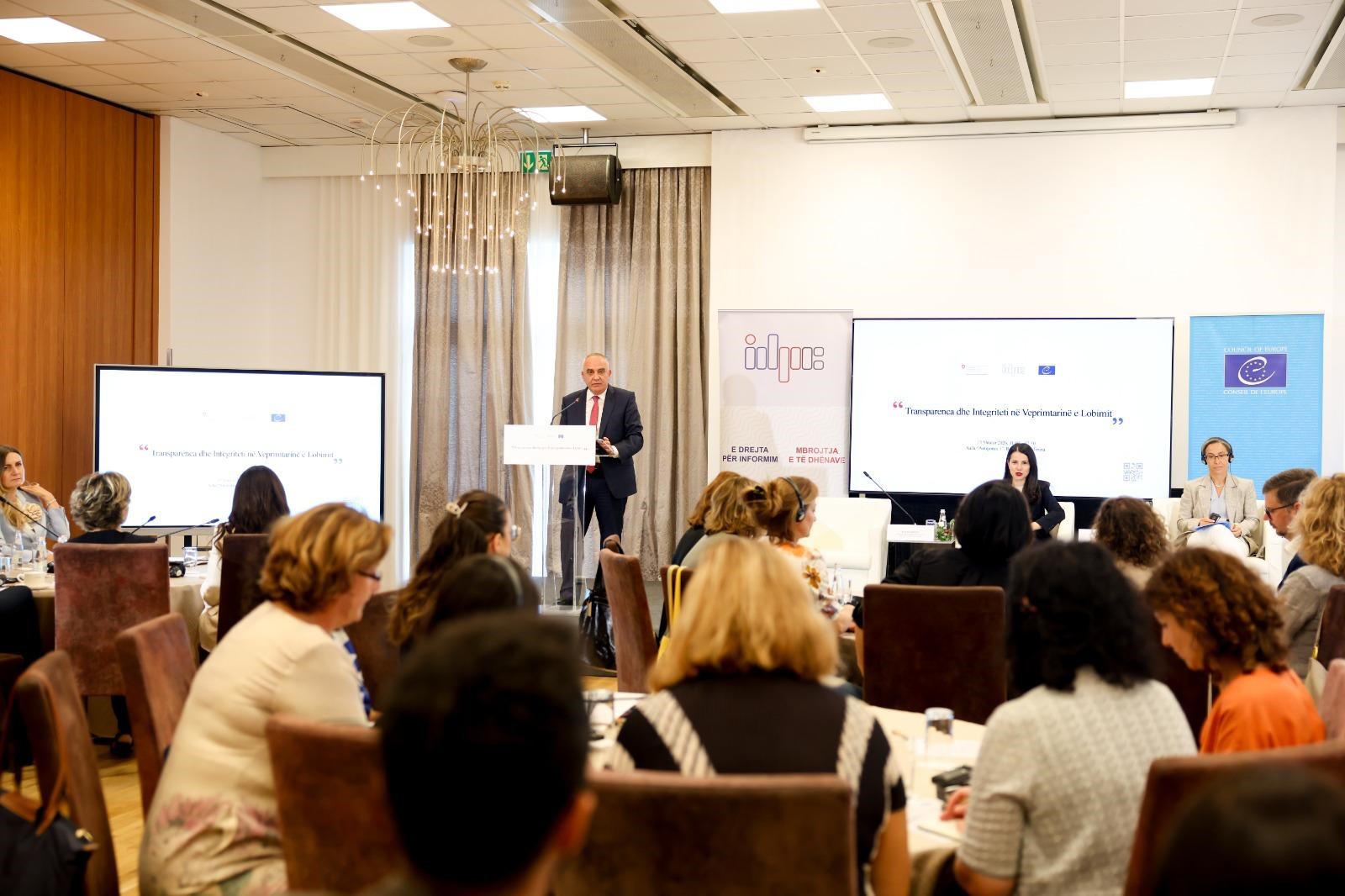
The Information and Data Protection Commissioner organized a meeting titled “Transparency and Integrity in Lobbying Activities,” focusing on the new legal framework for lobbying in the Republic of Albania and the package of secondary legislation that will enable its practical implementation.
Opening remarks were delivered by the Commissioner for the Right to Information and Personal Data Protection, Mr. Besnik Dervishi; the Minister of State for Public Administration and Anti-Corruption, Ms. Adea Pirdeni; the Head of the Council of Europe Office in Tirana, Ms. Giulia Re; and the Ambassador of Switzerland to Albania, H.E. Ms. Siri Walt. Representatives from public institutions, international partners, and civil society participated in the event.
In his address, Commissioner Dervishi emphasized that the new lobbying framework aims to increase transparency regarding how various interests and actors interact with public decision-making processes.
“When the word ‘lobbying’ is mentioned, the impression often arises that conversations take place in dark corridors, perhaps even behind heavy, drawn curtains. The new legal framework—as well as our objective—is to shed light on this environment and establish an institutionalized relationship,” the Commissioner stated.
Dervishi emphasized that in a democratic system, it is natural for decision-makers to heed the expertise and interests of various groups; however, problems arise when such influence remains invisible or when the opportunity to be heard is perceived as a privilege reserved for a select few actors.
“In a democratic system, interests knock on the door of decision-making. Yet, the public needs to know who is knocking, on whose behalf, and for what purpose,” he stressed.
Law No. 12/2026 “On Lobbying in the Republic of Albania” has tasked the Commissioner’s Office with overseeing the new framework and with the authority to draft and adopt implementing regulations. The Commissioner highlighted that this new responsibility is not detached from the institution’s long-standing role as a guarantor of the right to information; rather, it is directly linked to transparency, access to information, and the accountability of public institutions.
“The right to information enables the public to be aware of decisions and documents, while transparency in lobbying activities reveals the path of influence that precedes those decisions. Both serve to foster a more open and accountable public administration,” Dervishi stated.
The Minister of State for Public Administration and Anti-Corruption, Ms. Adea Pirdeni described the establishment of the new lobbying framework as a difficult and challenging process, underscoring the importance of placing transparency at the core of the interaction between interest groups and public decision-making.
“With the lobbying law, we have chosen to place transparency at the foundation of how interests interact with public decision-making. Our responsibility now is to turn this principle into reality through clear rules, accountable institutions, and a standard that strengthens public trust in decision-making,” stated Pirdeni.
The Head of the Council of Europe Office in Tirana, Ms. Giulia Re, emphasized the importance of transparency and clear rules in this area.
“Lobbying is a legitimate part of democratic participation, but it must be transparent, accountable, and subject to clear rules. Transparency does not hinder the dialogue between decision-makers and those affected by their decisions; on the contrary, it helps ensure that this dialogue takes place openly and fairly,” said Re.
The Ambassador of Switzerland to Albania, H.E. Ms. Siri Walt, highlighted that transparency in the decision-making process strengthens trust in public institutions.
“When citizens can see who influences public decision-making and how decisions are reached, trust in public institutions grows. Transparency helps create a level playing field for all stakeholders and reduces opportunities for illicit influence and corruption,” stated Walt.
During the event, a package of eight draft bylaws was presented; this package was drafted with expertise from the Council of Europe and funding from the Swiss Agency for Development and Cooperation. The acts specifically define the operation and administration of the Lobbying Registry, registration procedures, the declaration of lobbying activities, the identification and management of conflicts of interest, data verification and updating, document management, and standards of conduct.
The meeting continued with a discussion on lobbying transparency and integrity in decision-making from a public policy perspective, European standards and practices for the effective implementation of the legal framework, and the civil society perspective on transparency, participation, and integrity in decision-making. Representatives from the General Directorate against Corruption, the Council of Europe, and the European Movement in Albania contributed to the panel.
The event continued with an open discussion, during which participants had the opportunity to present questions, comments, and recommendations regarding the package of draft acts and the operational framework of the new lobbying system.
The contributions of public institutions, experts, civil society, the business community, and stakeholders who will interact with the lobbying system will be crucial to establishing a mechanism that is functional, transparent, and practically implementable.